
The first benchmark used a public figure whose name sits on almost every account he owns, so grading was easy. This second round of Fingerprint vs OSINTsearch vs Revealer does the opposite. On 2026-09-05 I ran the handle srhoe through all three tools, exported the JSON from each, and counted. The catch is that srhoe is held by several different people. A designer in Colombia, an athlete, a 2013 Twitter account with two followers and a verified Instagram account with over a million share five letters, and the question is not how many rows come back but which export helps you tell them apart.
The short version: Fingerprint returned the widest list and the richest raw extras, Revealer returned the tidiest list and ran the handle through a breach index on the way, and OSINTsearch returned the only file that names the competing identities as alternatives instead of quietly picking one, then followed the links it found into a second sweep. Each vendor curates its own pool, and the three together reached 49 platforms. The first benchmark covers the single-owner case.
How this Fingerprint vs OSINTsearch vs Revealer round was run
Same method as last time. One query, one paid account on each tool, JSON export downloaded, platform names normalized before matching so that "Twitter" and "x" count as one, as do the Minecraft and NameMC modules that point at the same page. Fingerprint and Revealer ran with recursion off. OSINTsearch ran at depth 3 to show what its deep search does with a handle like this; the sweep numbers below are for the primary scan only.
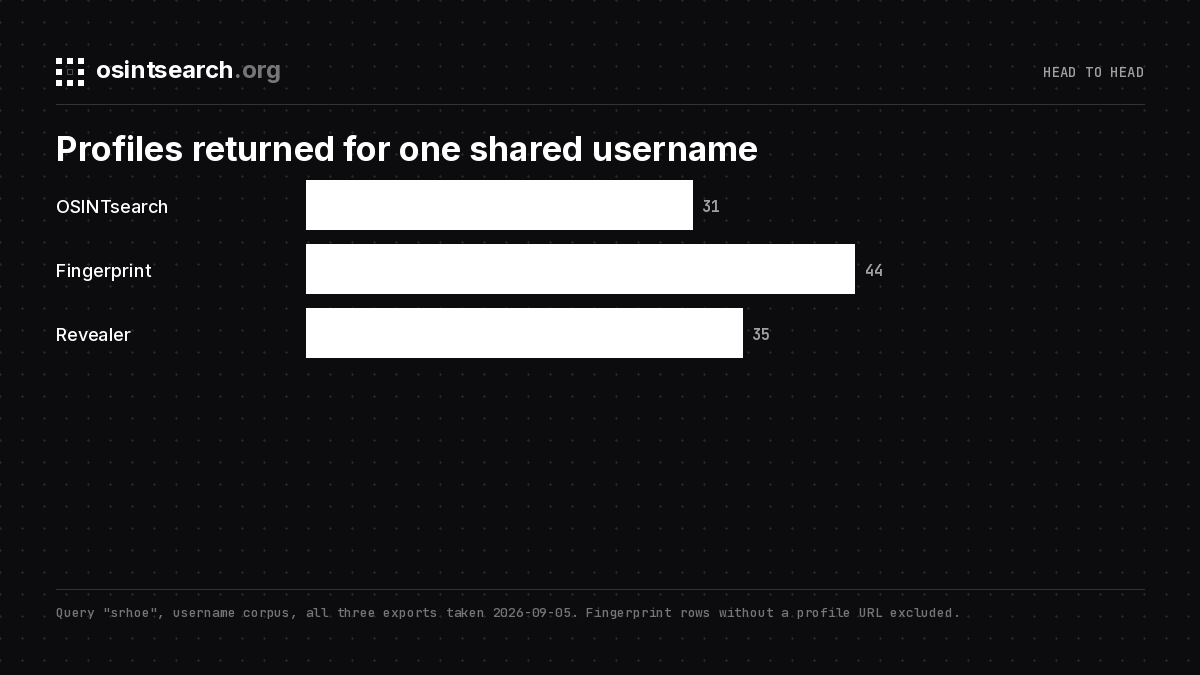
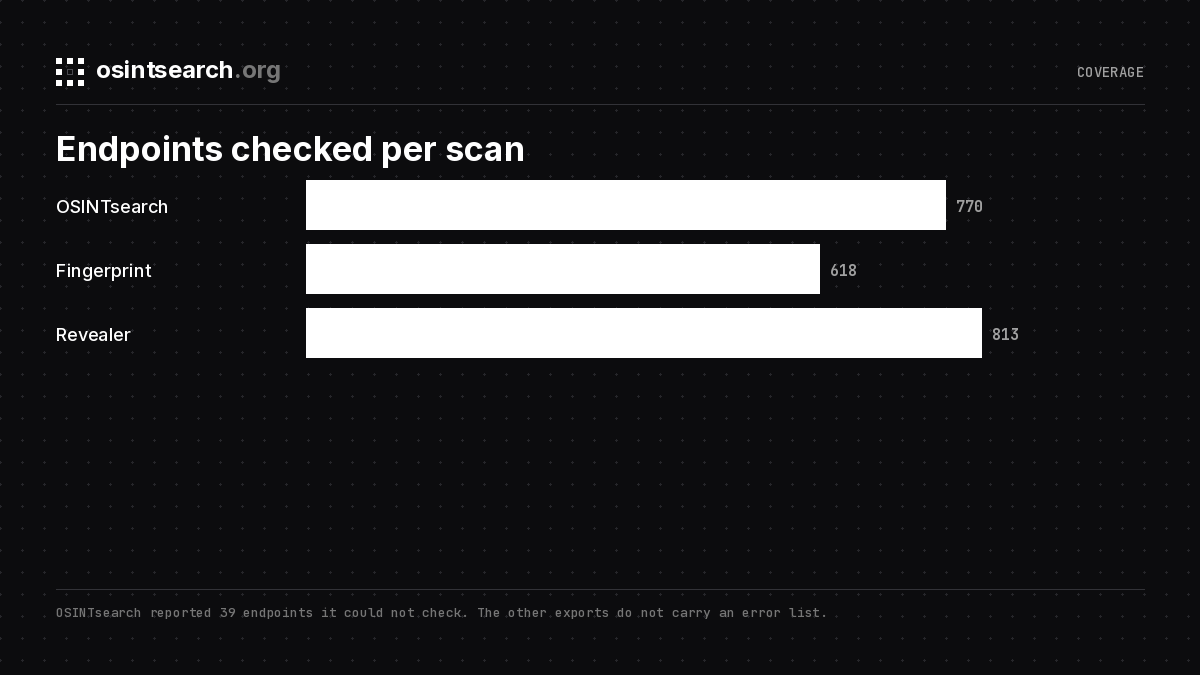
| Tool | Endpoints checked | Profiles returned | Time | Audit list | Extras |
|---|---|---|---|---|---|
| OSINTsearch | 770 | 31 | 28.0 s | 39 endpoints named, with reason | Identity dossier, deep search report |
| Fingerprint | 618 | 44 (46 rows) | 20.4 s | none in export | Account state flags, guessed emails |
| Revealer | 813 | 35 | 30.4 s | none in export | Breach and stealer log check |
Fingerprint's export reports 618 platforms checked this time, against 759 in the davidbombal export from the same day; the file does not say why. Its two rows without a profile URL, a list of five guessed email addresses and a Discord entry, are leads rather than accounts and sit outside the count.
Agreement: what three pools share
Twenty six platforms were returned by all three tools, the core you would expect for a handle in active use: GitHub, Instagram, Twitter, Twitch, Medium, Telegram, Patreon, Linktree, Mastodon, Truth Social, the typing and rhythm game sites, and the payment handles on Venmo and Cash App. Another eight came from two tools and fifteen from one. The union is 49, and no single pool covers it: run two.
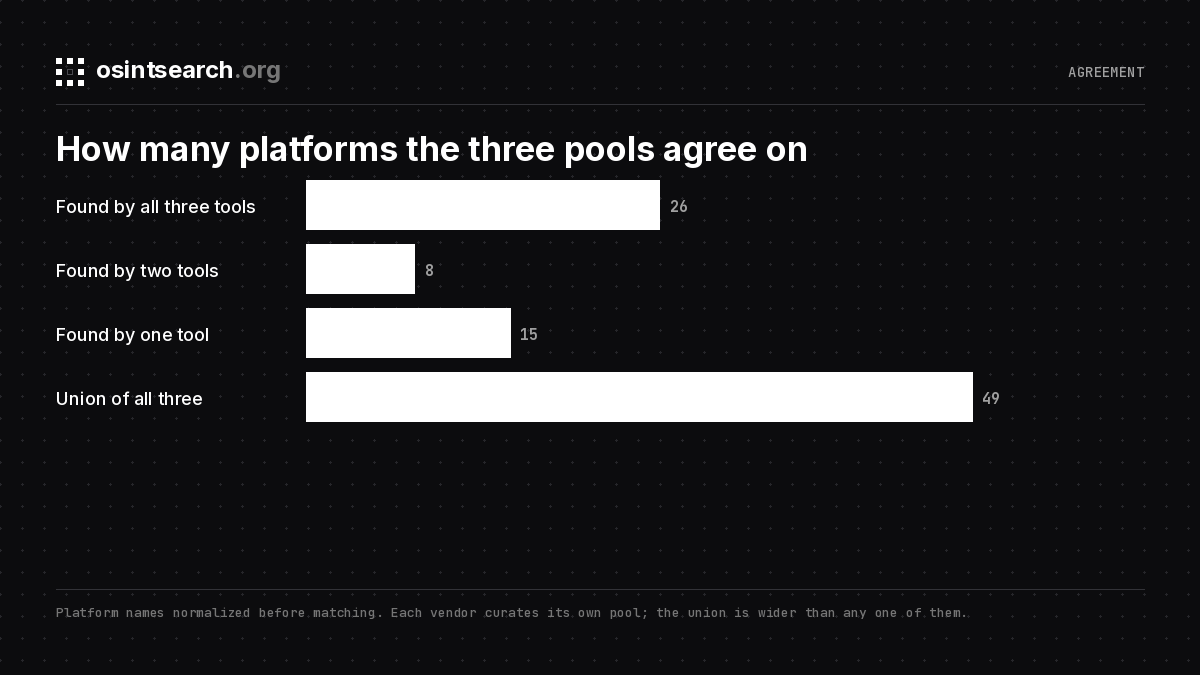
Fingerprint's pool is the widest here, reaching into a professional network, a VR platform, a print-on-demand shop and a pair of short-video services that share one user id, so one account appears twice under two brands. Its rows carry the flags that make triage fast, is_banned, is_suspended, default_pfp, and a last-active timestamp on six profiles. Two rows deserve a second look: the Quora and Scribd entries carry different usernames entirely, "Amy-Multani-1" and "Stephanie-Clark-Rhoe", so they were matched on a name fragment rather than the handle. Fingerprint returns them honestly; the reader has to notice.
Revealer's list is the tidiest. Thirty five profiles, one duplicate flagged by its own alsoReportedBy field, and one platform nobody else returned, a Rocket League stats tracker. It also ran the term through its breach and stealer log index and reported zero for both. With the first handle that index produced two email addresses; here it produced none.
OSINTsearch's 31 hits sit inside the core, all 26 shared platforms plus four it shares with Revealer, each row with parsed links, a source timestamp and a user id where the platform exposes one. What it adds on top of the rows is the subject of the next two sections.
Five names, one handle: the identity dossier
Ask the three exports who srhoe is and you get three kinds of answer. Fingerprint and Revealer give a display name per row and leave the synthesis to you. OSINTsearch gives you a probable name with its sources, then every competing name it saw, each with the platform that carried it.
"probable_name": { "value": "Kevin Roberts", "confidence": 0.13,
  "sources": ["venmo", "github", "cashapp", "instagram"],
  "alternatives": [
    { "value": "Shaw Rhoe", "sources": ["strava"] },
    { "value": "Sarah O",   "sources": ["behance"] },
    { "value": "Kevin",     "sources": ["leetcode"] },
    { "value": "WE.",       "sources": ["twitter"] } ] },
"probable_location": { "value": "United States", "confidence": 0.06 }
Read the confidence first. Last time eighteen platforms agreed on one name and the score was 0.31; here four agree and the score is 0.13, so the alternatives block is doing the real work. The Behance account called "Sarah O" is in Medellín, Colombia and links to a different Instagram account entirely. The Strava account says "Shaw Rhoe". The Twitter account dates from February 2013, has two followers and one post, and calls itself "WE.". None of those belong with the verified Instagram account, and the dossier says so by listing them rather than folding them into one guess. On a shared handle the honest output is a short list, not a name.
It also stacks the eight profile pictures it collected so you can compare faces at a glance. Twelve of the 31 rows use the handle itself as the display name; Fingerprint's rows print fourteen such names and Revealer's twenty three, and both files leave you to sort them.
Links, a second sweep, and the audit trail
Six OSINTsearch rows carry parsed outbound links, the pivots that turn a list into a map. GitHub points at a Twitter account under a different spelling, 5rhoe. The link-in-bio pages on Hoobe and Kick point at six and seven destinations each, including a Twitch channel spelled srh0e and a TikTok spelled 5rh0e. Stack Overflow points at srhoe.com. Behance points at an Instagram account called typha.minima, which is a different person's pivot, not the same person's.
Deep search took those four spellings as seeds, swept each at depth 1, and reported the result plainly:
"deep_search": { "requested_depth": 3, "total_searched": 4, "total_discovered": 0,
  "swept": ["srh0e", "5rhoe", "5rh0e", "typha.minima"], "hits": [] }
Zero new profiles, and a useful zero: the variant spellings did not open a second cluster, and the seeds are recorded so nobody repeats the work. The free vs Pro post walks through this exact export and what the paid plans add to it: export, breach records and this sweep. Neither of the other files has a place for a walk like this; Fingerprint's deep search was off for this run, and Revealer's recursion runs through email discovery, which had nothing to work with here.
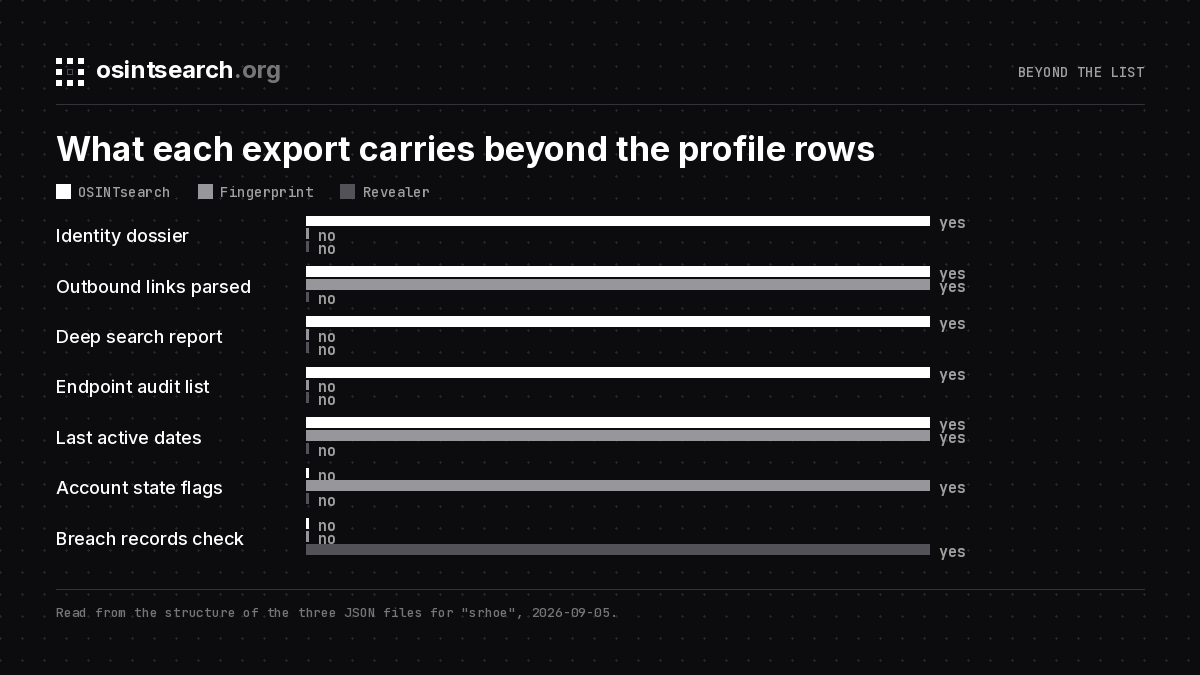
The OSINTsearch export closes with two lists the other files do not have: the 39 endpoints that did not answer inside the scan window, each with a reason code, and the full roll of 698 platforms that answered "not found". With the 31 hits that accounts for all 770 endpoints. The Fingerprint and Revealer exports report a total checked and stop there; a platform absent from their files may have answered "no" or may never have answered, and the file cannot tell you which. For a report with a client's name on it, that is the difference between "not found" and "not checked".
Price, and which one to run on an ambiguous handle
Fingerprint sells tokens: $30 a month for 500 on Pro, $100 for 2,500 on Max, with deep search on Max only. Revealer sells daily allowances: $12.99 a month for 25 social and 50 breach lookups a day on Starter, $29.99 for 150 social lookups a day, and $79.99 for 500 a day with stealer logs. OSINTsearch sells weekly allowances: 15 free searches a week that show every hit in full, $20 for 50 a week on Starter with CSV plus JSON export and breach name and date, and $49.99 for 500 a week on Pro with deep search and full breach records. The pricing page has the ladder. Revealer has the lowest entry price and Fingerprint the cheapest tokens at volume; OSINTsearch is priced for what each hit carries. The osint.industries alternative post puts all three against a fourth vendor on cost per lookup.
- Widest first pass: Fingerprint. The most rows, the fastest sweep, state flags on every row. Budget time to triage the name-fragment matches.
- A clean list plus a breach check: Revealer. Every row corroborated, duplicates flagged, breach index consulted.
- Telling the people apart: OSINTsearch. The dossier lists the competing names with their sources, the links are parsed, the variant spellings are swept. Try it on the live search; the free plan runs the full 770-endpoint sweep and shows the results unmasked.
FAQ
Which of the srhoe accounts belong to the same person?
No export answers that, and this post does not either. The OSINTsearch dossier groups four platforms behind one probable name at 0.13 confidence and lists four alternatives with their sources. Treat each cluster as a separate lead.
Why did deep search find nothing new?
It swept the four variant spellings it pulled from the parsed links and none opened a second set of accounts on the 770 endpoints. The export records the seeds and the zero, so the negative result is reusable rather than lost.
Why does Fingerprint report 618 platforms here and 759 last time?
Both numbers come from the "Platforms checked" line of its own exports, taken the same day, and the file does not explain the difference. Pools change between runs on every vendor, which is one more reason to keep the export.
Can I reproduce this?
Yes. Run the handle on all three tools, export JSON from each, normalize platform names, and count. The OSINTsearch export format is documented in the deep search post.
Three files, five names
A single-owner handle rewards breadth; a shared handle rewards structure. Fingerprint for the widest net, Revealer for the cleanest list, OSINTsearch for the file that tells you there are several people here and shows its working. When the handle is ambiguous, run two and read the dossier first.


