
Searching for a PeekYou alternative usually means one of two things. Either you typed a name into a people-search engine and got a record with an age bracket, a city and some possible relatives when what you wanted was the person's actual accounts, or you typed a username and got a list of names when what you wanted was the profile behind the handle. Both are the same mismatch: a people-search index answers "who is this person" from stored records, and a live social search answers "which accounts exist under this identifier, and what do they say right now." This post explains the difference using PeekYou's own description of itself and a real OSINTsearch export, and says which to use for which job.
To be clear up front, PeekYou is good at what it was built for: running since 2006, free for basic lookups, with a plain-language privacy pledge and an on-site opt-out. It is not a bad tool; it is a different instrument.
What PeekYou says it is
PeekYou describes itself as "a free people search engine site that lets you find and connect with those that matter most." Its About page puts the idea well: "PeekYou places the individual at the center of the Internet. For every public weblink, PeekYou tries to answer the question, 'Who made it?' or, where applicable, 'Whom is it about?'" The technology, in its own words, "analyzes content from over sixty social sites, news sources, homepages and blog platforms." The homepage offers People Search by first and last name with a US state selector and a separate Username Search tab.
The record it returns is person-shaped. Its results pages carry a name, an age bucketed by decade, a city and state, a list of past locations, possible relatives and a View Details link, with social profiles listed platform by platform below. Deeper records, such as phone numbers, address history and background reports, are handed to sponsored partners such as BeenVerified, TruthFinder and Instant Checkmate rather than sold by PeekYou itself, and email addresses are shown masked until you go to a partner. PeekYou publishes no subscription price of its own, and no export feature is described on the site.
Two statements matter for what follows. First: "PeekYou only displays public web content and always respects requests for privacy." Second, the footer disclaimer: "PeekYou is not a consumer reporting agency per the Fair Credit Reporting Act. You may not use our site or service, or the information provided, to make decisions about employment, admission, consumer credit, insurance, tenant screening or any other purpose that would require FCRA compliance." OSINTsearch says the second one too.
Index versus live scan
A people-search index is built ahead of time. It crawls sources, resolves them to a person, stores the resolved record and serves it back when you search. That is why it can answer a name query in one page, and it is why the record looks the way it does: age brackets, locations and relatives are what public records and crawled pages yield when you merge them. It is also why the record can be stale. A profile that changed its handle, was banned, or was created last month is only in the index once the crawler has been back.
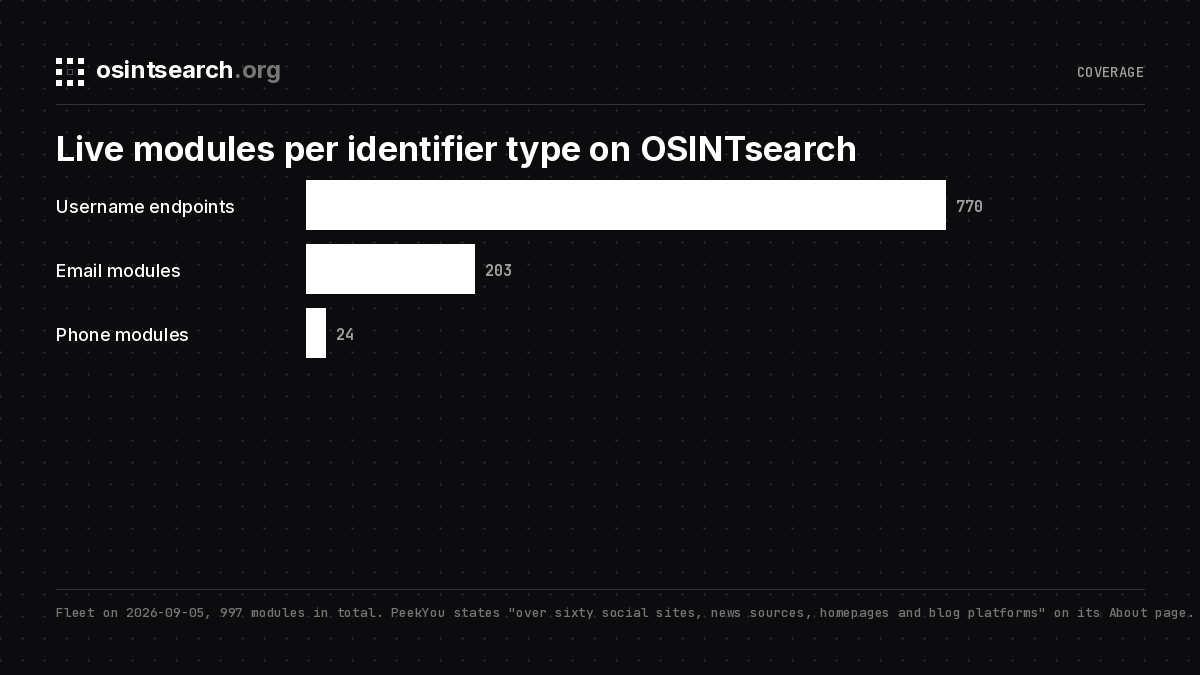
A live social search does no merging in advance. You give it a username, an email or a phone number; it queries each platform at that moment and returns what the platform says today. OSINTsearch runs 770 username endpoints, 203 email modules and 24 phone modules this way, 997 modules in total. The output is account-shaped rather than person-shaped: one card per platform where the identifier exists, carrying whatever that platform exposes publicly, plus an identity block that reports where the cards agree.
| People-search index (PeekYou) | Live social search (OSINTsearch) | |
|---|---|---|
| Starts from | A name, or a username matched to names | A username, email or phone number |
| Source of the answer | Stored records merged ahead of time | Each platform, queried at search time |
| Coverage as stated | Over sixty social sites, news, homepages, blogs | 770 username, 203 email, 24 phone modules |
| Record shape | Name, age bracket, city, locations, possible relatives, profile links | Per platform: id, display name, bio, joined date, followers, location, links, former usernames |
| Deeper data | Sponsored partner reports | Deep search and breach records on Pro |
| Export | Not described | CSV and JSON from Starter |
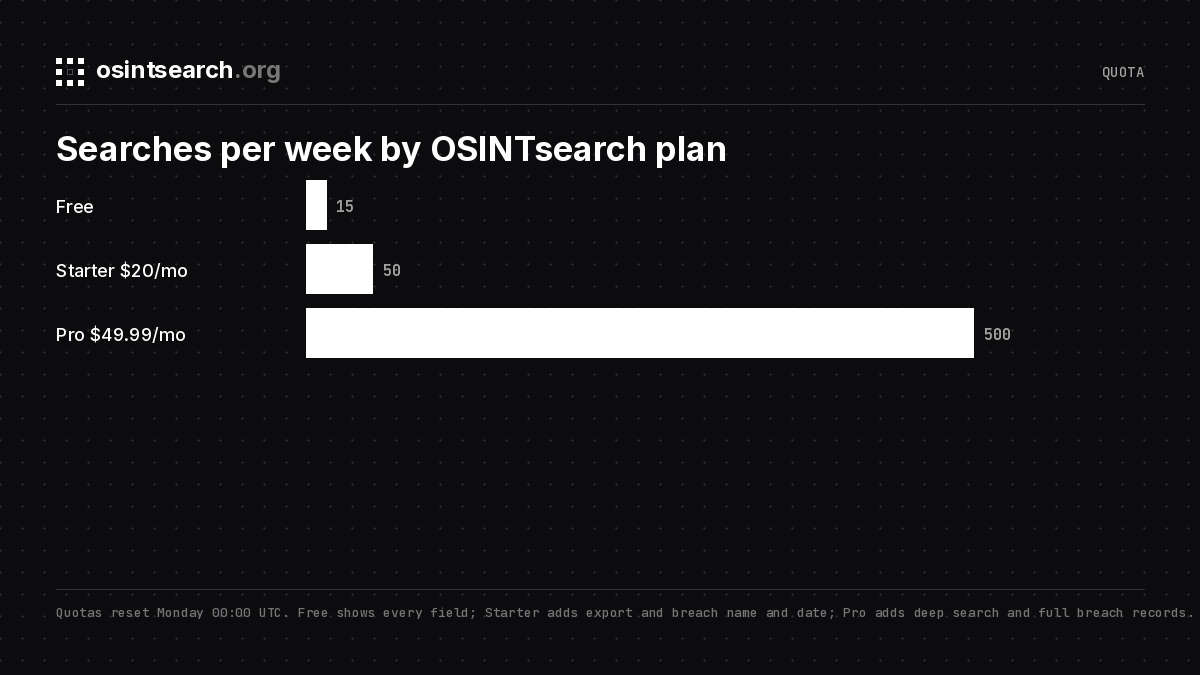
| Price | Free; no PeekYou-branded plans published | Free 15 a week; Starter $20; Pro $49.99 |
| Opt-out | On-site privacy pledge and CCPA opt-out | Email or username opt-out |
What a live result carries that an index does not
Here is what the difference looks like on a real handle. On 2026-09-05 I ran davidbombal, a public figure, through OSINTsearch: 770 endpoints in 29.2 seconds, 59 accounts found. Of those 59 cards, 47 carry a display name, 41 a platform user id, 41 a profile picture, 26 a joined date, 23 a bio, 15 a follower count, 14 a location and 9 a parsed set of outbound links.
- Bios. The YouTube card carries the channel description in full, and that description lists the owner's Discord, Twitter, Instagram, LinkedIn, Facebook and website. GitHub says "Author, Instructor and YouTuber".
- Joined dates. X, created 12 July 2009. YouTube, 6 February 2008. Instagram, March 2017. TikTok, 10 January 2019. Sort a shared handle's cards by age and the person who has held it longest stands out from the people who picked it up later.
- Platform ids. X 56191110, GitHub 22679022, Instagram 4942626039. A numeric id survives a rename and, on Instagram, a ban.
- Former usernames. Where Instagram lists them, the module exposes prior handles, and it resolves banned accounts by their numeric id rather than reporting them missing. The old usernames guide and the deleted Instagram account post show how to work that trail.
- Outbound links. GitHub links to the YouTube channel; Clubhouse links to the X account; Threads links to a tap.bio page; X links to davidbombal.com.
Above the cards the identity block does the merge for you, on the spot, and shows its work: a probable name of David Bombal from 18 agreeing platforms, two websites, a second username variant (davidbombal.eth, from ENS), and eight profile pictures to compare by eye. That is the people-search answer, derived live from the accounts rather than served from a record.
{
  "platform_label": "Twitter (X)",
  "username": "davidbombal",
  "user_id": "56191110",
  "display_name": "David Bombal",
  "verified": true,
  "followers": "183324",
  "location": "England",
  "website": "https://www.davidbombal.com",
  "created_at": "2009-07-12T21:06:30.000Z"
}
The legal difference between a records index and a live search
PeekYou states that it is not a consumer reporting agency. OSINTsearch states the same: it is not a consumer reporting agency, and it must never be used for employment, tenancy, credit or insurance decisions. Where the two differ is in what exists after the search. A people-search index is, by design, a stored record about a person: age, locations, relatives, merged and kept so it can be served again. That is why opt-out is such a large part of the people-search conversation, and it is to PeekYou's credit that it runs an on-site privacy pledge and a CCPA opt-out rather than an email round trip.
A live search stores no such record. OSINTsearch is export-only: nothing is kept beyond anonymous query metadata for abuse prevention, for at most 90 days, and the result exists only on your screen and in the CSV or JSON you download. The opt-out path is still there, by email address or username, for anyone who does not want their public accounts surfaced, and it applies to future searches because there is no stored dossier to delete.
Choosing a PeekYou alternative by the identifier you hold
If you hold a full name and a US state and want a quick, free sense of a person's public web presence, PeekYou is still a reasonable first stop. If you hold a username, an email address or a phone number, start with a live search, because the index will convert your identifier into a name match and lose the account detail on the way.
The OSINTsearch free plan gives you 15 searches a week with every field on every card, no card required. Starter, at $20 a month on the pricing page, raises that to 50 a week and adds CSV and JSON export plus breach name and date; Pro, at $49.99, gives 500 a week, deep search at four depths and full breach records. The email side is covered in what's behind the email: 203 modules that confirm a registration and return masked recovery hints. For a wider field of username tools, including report builders like the one in the Predicta Search alternative post, see the best username OSINT tools roundup.
FAQ
Is PeekYou free?
Its basic name and username lookups are free and need no login, per its own site. Deeper records such as phone numbers and address history are offered through sponsored partners, and PeekYou publishes no subscription plan of its own.
Does OSINTsearch search by name?
No. It is identifier-first: username, email or phone number. The identity block then reports the probable name and location where the found accounts agree.
Why does a live search show a joined date and an index does not?
Because the live search reads the platform's profile endpoint at query time, and creation dates, bios and follower counts are fields the platform serves. An index stores the merged person record, not the per-platform profile.
Two questions, two tools
A people-search index tells you who a name belongs to. A live social search tells you what an identifier's accounts say today, with the bios, dates, ids and links that let you prove it. Pick the tool that matches the identifier in your hand, and when the answer matters, run the live search and keep the export.


