
A username search benchmark only means something if you can see the raw exports, so this one starts with three files. On 2026-09-05 I ran the handle davidbombal through OSINTsearch, Fingerprint (fingerprint.to) and Revealer (revealer.us), downloaded the JSON each tool produces, and counted. Not what the landing pages claim, what the files contain. I build OSINTsearch, so assume bias and check the numbers yourself; the exports are linked at the end.
The short version: Fingerprint is fast and wide, Revealer pairs its sweep with a breach index, and OSINTsearch returns the deepest profile per hit, the only identity dossier, and the only export built to be audited. Each vendor curates its own pool, and the three together reached 77 platforms, more than any one pool alone. If the case matters, run two.
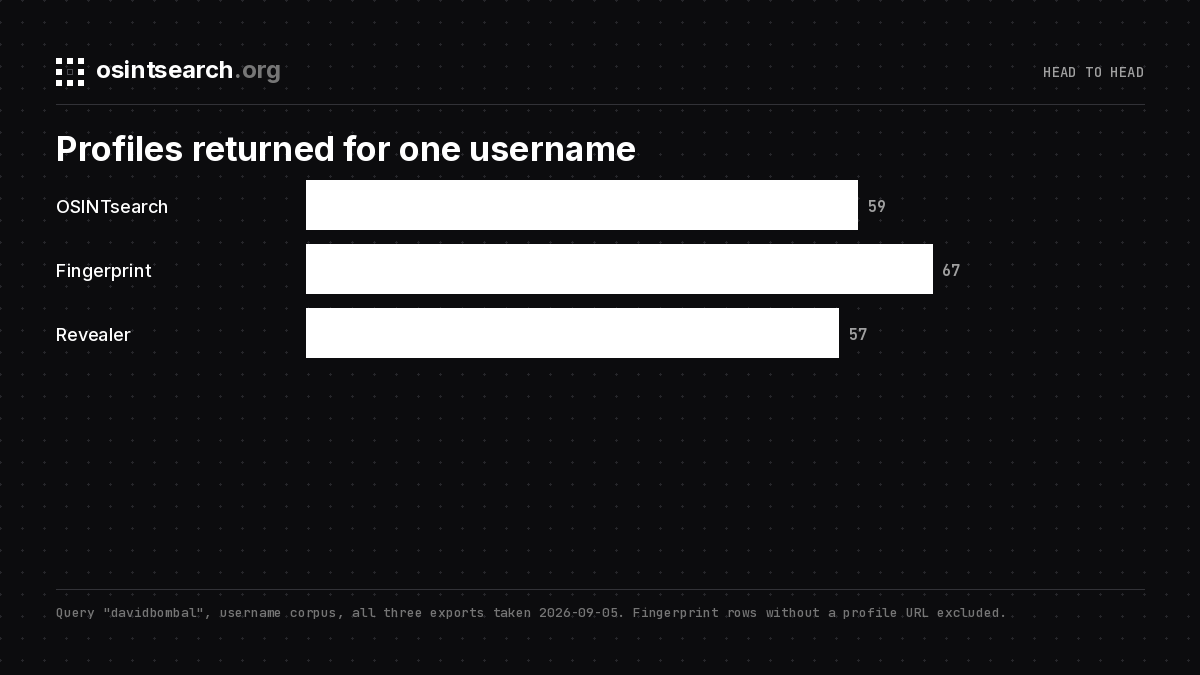
How the username search benchmark was run
One handle, chosen because the person behind it is a public figure with accounts across developer, creator and gaming sites, and because his name is on most of them, which makes false positives easy to spot. Each tool ran once on a paid account with recursive search off, so the comparison is sweep against sweep. Platforms were matched by normalized name, so "Twitter" and "x" count as one.
| Tool | Endpoints checked | Profiles returned | Time | Errors listed |
|---|---|---|---|---|
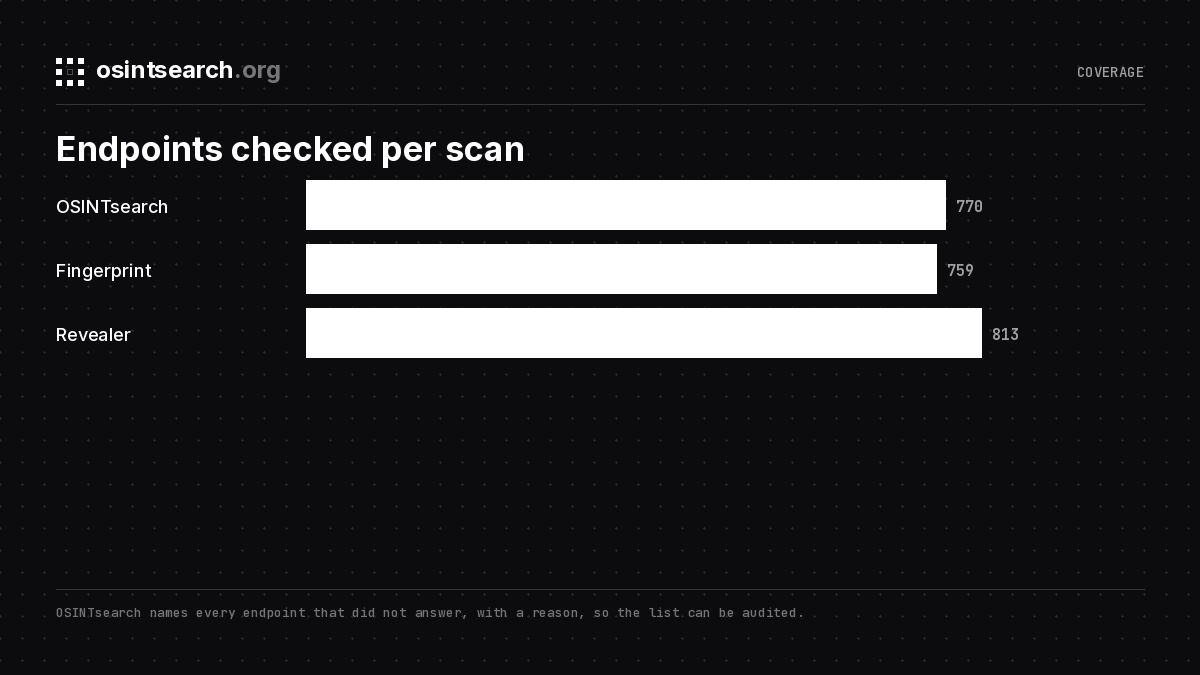
| OSINTsearch | 770 | 59 | 29.2 s | 47, with reason |
| Fingerprint | 759 | 67 (69 rows) | 20.6 s | none in export |
| Revealer | 813 | 57 | not in export | none in export |
Fingerprint's two extra rows are a "RegisteredEmails" list of six guessed addresses at common providers and a Discord entry with no profile URL. Both are leads rather than profiles, so they are left out of the count.
Username search benchmark results: who found what
Forty seven platforms were found by all three tools. That is the core: YouTube, Twitter, Instagram, GitHub, TikTok, Threads, Twitch, Mastodon and the long tail of developer and creator sites. The interesting part is the edges.
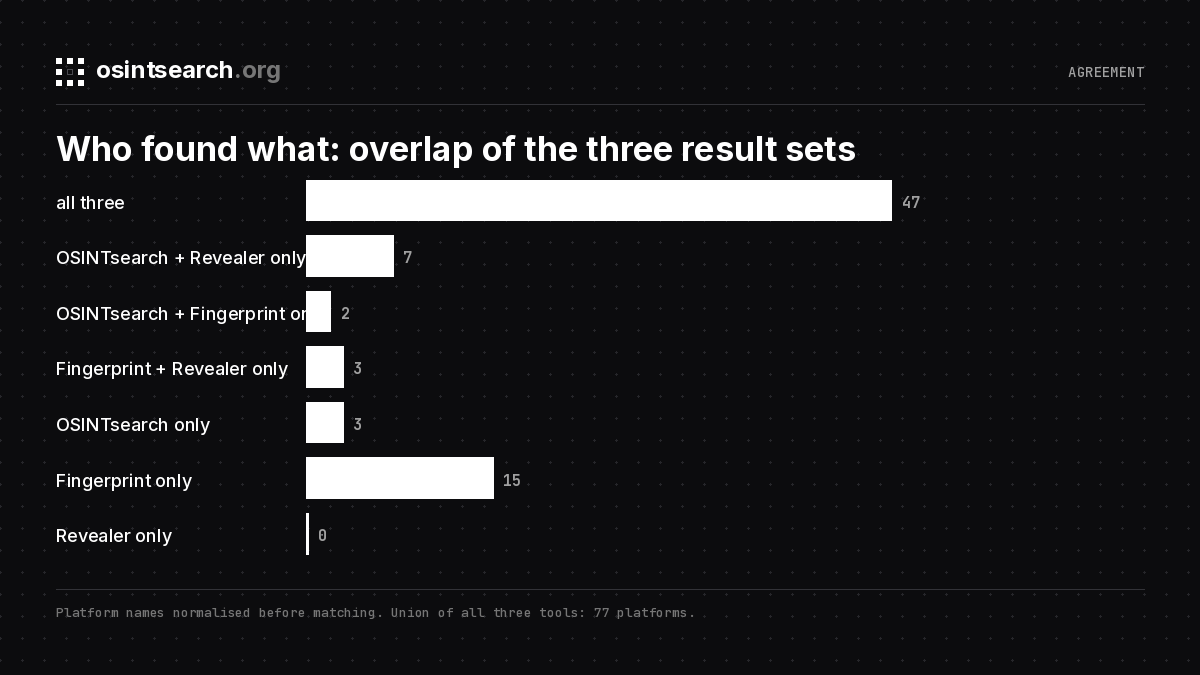
Fingerprint's pool reaches into marketplaces and short-video apps that the other two treat as out of scope, and its extra rows show both sides of a wide net. Several are clearly the same person: one bio repeats his YouTube and Discord links, one headline mentions the three million subscribers. Others are handle squats: a payment page that belongs to someone with a different name entirely, and accounts with zero followers and a generic display name. Fingerprint reports them correctly; the reader has to judge them. A handle match is never an identity match, and this query shows why.
OSINTsearch reaches where deletion cannot. Its unique hits were a security community profile, a Periscope archive entry, and an Internet Archive contributions search listing five dated snapshots of his GitHub repositories. Archive entries survive account deletion, which is the same reason OSINTsearch resolves banned Instagram accounts by numeric id: the record outlives the page.
Revealer found nothing unique, and that is not a criticism. Of the 57 profiles it returned, every one was corroborated by at least one other tool, and its export flags when two of its own modules report the same account. It is the tidiest of the three lists.
Depth: what each hit carries
A list of URLs is where a username sweep starts, not where it ends. The second chart looks past the profile list at what each export adds on top of it.
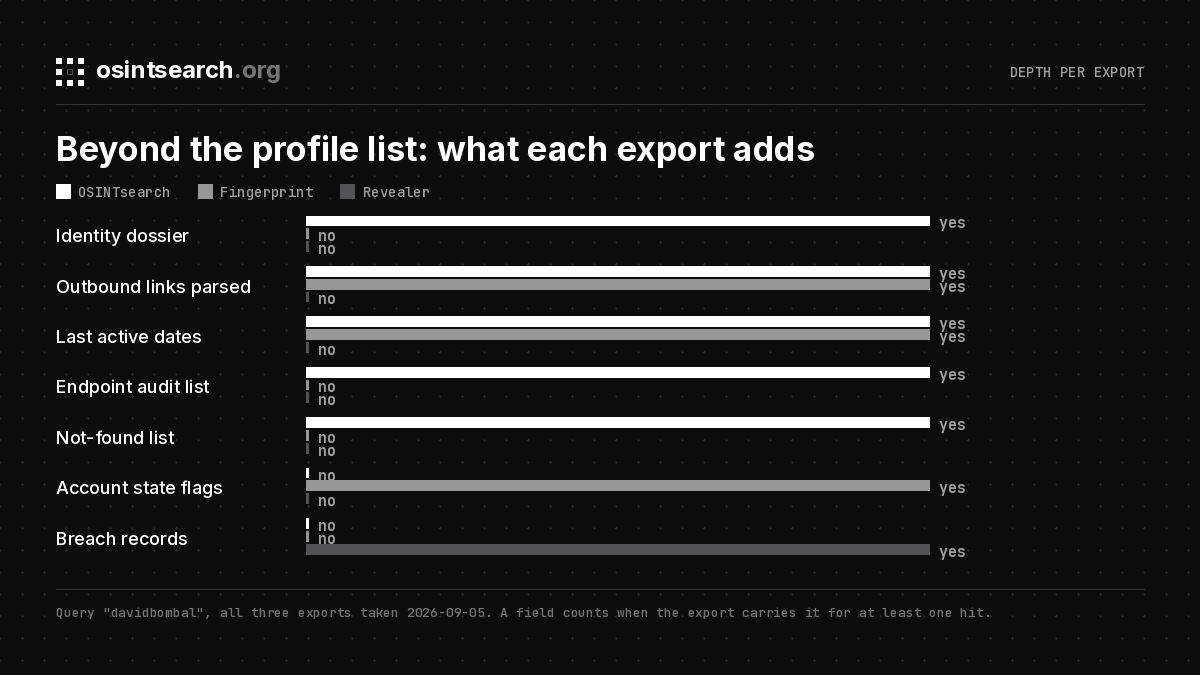
Fingerprint's extras block is the richest raw dump of the three, with account-state flags such as suspended, banned and default picture that make triage faster. If you want account state at a glance, Fingerprint is the export to open first.
OSINTsearch leads the narrative fields, the ones that decide the next pivot. Bios on more of its hits than either rival, and outbound links parsed on one in five: GitHub and Clubhouse both point at his Twitter, SoundCloud at his YouTube, YouTube at his website, LinkedIn and Instagram. Those links are what a deep search follows on the paid plans, and they are the reason a bio is worth parsing rather than displaying.
Revealer sits in the middle on most fields and does something the other two do not: it ran the handle against a breach index and returned three records, including a Gmail address from a 2019 Canva breach and a second address on his company domain from a 2022 scrape. That is an email pivot for free, inside a username search, and it is the single most useful thing in its export.
The dossier, and the error list
Two things in the OSINTsearch export have no equivalent in the other two files. The first is the identity block. Eighteen of the 59 profiles carried the same display name, so the export names a probable identity and a probable country and lists the sources for each, plus every username variant it saw, which here included an ENS name, davidbombal.eth. It also stacks the eight profile pictures it collected so you can see at a glance whether the accounts share a face.
"probable_name": { "value": "David Bombal", "confidence": 0.31,
  "sources": ["mix", "odysee", "behance", "github", "threads", "twitter", "..."] },
"probable_location": { "value": "United Kingdom", "confidence": 0.05 },
"username_variants": [ { "value": "davidbombal" }, { "value": "davidbombal.eth", "sources": ["ens"] } ]
The confidence numbers are deliberately low. A name eighteen platforms agree on is still a display name, and the export says so.
The second is the audit trail. OSINTsearch names every endpoint that did not answer inside the scan window, with the reason, alongside the full list of platforms that answered "not found". Neither competitor export says which endpoints it heard back from, so a missing platform in their files could be a genuine miss or a silent timeout, and you cannot tell which. For a report that ends up in front of a client, that difference matters more than a few extra rows.
Price for the same search
All three are cheap next to enterprise OSINT suites, and the quotas are shaped differently. Fingerprint sells tokens: $30 a month for 500 on its Pro plan and $100 for 2,500 on Max, with deep search on the higher tier. Revealer sells daily allowances, from $12.99 a month for 25 social lookups a day, and includes breach and stealer log checks. OSINTsearch sells weekly allowances: $20 for 50 searches a week on Starter, $49.99 for 500 a week on Pro with deep search and full breach records, and a free plan of 15 searches a week with every field shown, so you can test the sweep before paying. The pricing page has the full ladder.
Per lookup, all three are a rounding error next to an hour of analyst time. Revealer has the lowest entry price and Fingerprint the cheapest tokens at volume. OSINTsearch is priced for what each hit carries: the depth, the dossier, the audit trail and the export, which is where the hours go once the list exists.
Which one to run
- Breadth on a single pass: Fingerprint. Most rows, fastest sweep, best account-state flags. Expect to triage squats by hand.
- Breach correlation in the same search: Revealer. The breach index turned a username into two email addresses without a second query, and its list carried no noise.
- Depth, links and an auditable export: OSINTsearch. The most bios and outbound links, the identity block, and an audit trail for every endpoint. Try it on the live search.
The union of the three was 77 platforms, more than any one pool, and the exports are close enough in shape that merging them takes ten minutes. The username search tool guide covers how to read a merged set, and the Sherlock alternative post covers the free scripts for a first pass.
FAQ
Why does Fingerprint show 69 results if only 67 are profiles?
Two rows have no profile URL: a list of six guessed email addresses at common providers, and a Discord entry that confirms nothing beyond the handle. Both are leads, not accounts, so they are excluded from the profile count.
Are the adult site accounts real?
They are real accounts that use the handle, which is all any tool can say. Zero followers and a generic display name make them look like squats, and nothing in any export ties them to the person. Treat every handle match as a claim to verify.
Why do the three tools return different platform lists?
Each vendor curates its own module pool and refreshes it on its own schedule, so every pool has an edge the others lack. The 47 platforms all three agreed on are the core; the rest is where a second sweep earns its keep.
Can I reproduce this?
Yes. Run the handle on all three tools, export JSON from each, and count platforms after normalizing names. The three exports used here are described field by field above, and the OSINTsearch export format is documented in the deep search post.
Three tools, one file each
Each of these tools found accounts the other two did not. Fingerprint for breadth, Revealer for breach correlation, OSINTsearch for depth and an export you can audit. Pick by the question, and when the answer has to be complete, run two and merge.


