Who is behind a phone number is the question I get from people who have a missed call, a number in a message thread, or a contact in a dataset and want a name to put next to it. The truthful answer is that a public lookup, any public lookup, rarely gives you a name. What it gives you is a map of where that number is registered, and a few masked hints that the platforms themselves publish in their recovery flows. That map is often more useful than a name, but only if you know how to read it and where the edges are.
This post walks through what a reverse phone lookup on osintsearch.org checks, how the 24 phone modules are grouped, what comes back for a registered number, and what no public tool can tell you. It is the companion to who is behind a username, and the deeper mechanics are in the phone number OSINT guide.
Who is behind a phone number: what a lookup actually asks
A phone module does not ask "whose number is this". It asks a single service a narrower question: is there an account here registered to this number, and what does your public flow show for it. WhatsApp answers whether a number has an account. Facebook's recovery flow confirms the number and may show a masked recovery email. Instagram's shows a display name and avatar with a masked hint. Amazon, eBay, Microsoft, Airbnb, Battle.net, Snapchat, VK, Flipkart, Adobe and Yandex each answer the registration question in their own way. None of them send anything to the number, and none of them need you to sign in.
The result is a presence map. A number that is registered on WhatsApp, Instagram, Amazon and Microsoft is a number that belongs to a life; a number registered nowhere is a number acquired for a single signup, or one that is simply not in use online. That distinction is the first thing I want to know about any number, and it takes about a minute to establish.
The 24 modules, grouped by what they return
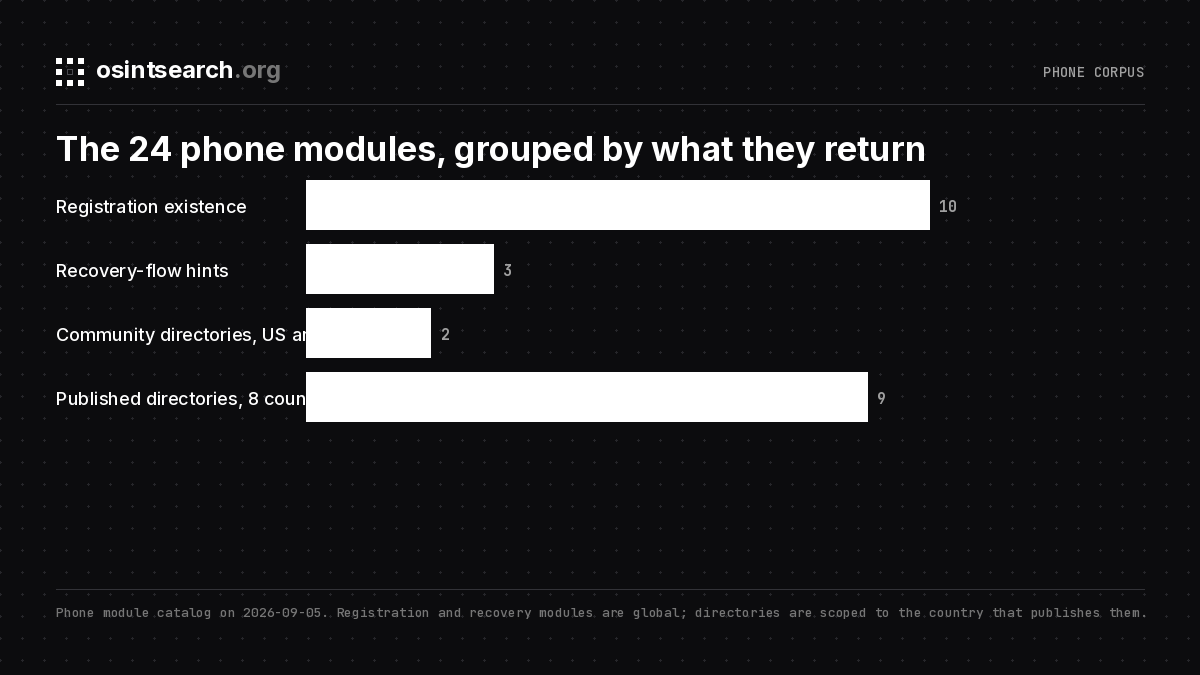
OSINTsearch runs 24 phone modules per scan on 2026-09-05. They fall into four groups, and the groups matter more than the count because each returns a different kind of evidence.
| Group | Modules | What comes back |
|---|---|---|
| Registration existence | whatsapp, snapchat, amazon, ebay, airbnb, battlenet, vk, flipkart, adobe, yandex | Registered yes or no |
| Recovery-flow hints | facebook, instagram, microsoft | Registered plus a masked email, display name or avatar where the platform shows one |
| Community directories, US and Canada | whocallsme, 800notes | Public comment threads about the number |
| Published directories, country-scoped | telsearch and local.ch (CH), dasoertliche (DE), 1881 (NO), reverseaustralia (AU), fonecta (FI), ja.is (IS), zlatestranky (CZ), panoramafirm (PL) | A listed name and sometimes an address, where that country publishes it |
The last group is where names come from, and it is scoped by design. A Swiss directory knows Swiss numbers. A number from outside a directory's country is still checked, and comes back as a clean not-found for that directory rather than a guess. That is the behavior you want: a negative you can trust is worth more than a positive you cannot.
The Microsoft module is a good example of how strict a hit should be. It reports a match only when the reset page carries explicit proof markers, so an interstitial or a challenge page never counts as a registration. Fewer false positives on the modules that matter most is the whole game in phone work.
Format first: E.164 or nothing
Every module wants the same input: a plus sign, the country code and the subscriber number, with no spaces, dashes or parentheses. OSINTsearch strips the punctuation and validates the result before any module runs, so you can paste a number as it appears in a message. If you are scripting against the export, do the normalization yourself so your inputs match what the export will echo back.
import phonenumbers
n = phonenumbers.parse("(415) 555-1234", "US")
e164 = phonenumbers.format_number(n, phonenumbers.PhoneNumberFormat.E164)
print(e164)                                    # +14155551234
print(phonenumbers.region_code_for_number(n))  # US
print(phonenumbers.number_type(n))             # mobile, fixed line or VoIP
The region and line type are things you compute locally, before you spend a search. A landline is not on WhatsApp, and a number from a bulk VoIP range is a strong hint that it was acquired for signups. Knowing that up front changes which hits you expect and which you should be surprised by.
A phone hit in the export uses the same profile shape as a username or email hit, with two fields that only recovery flows populate. The masked values are printed exactly as the platform shows them, on every plan, so the export never publishes more than the platform already did.
{
  "platform": "facebook_phone",
  "phone": "+14155551234",
  "masked_email": "j****@gmail.com",
  "scraped_at": "2026-09-05T12:00:00Z"
}
What a number can and cannot reveal
This is the table I wish every "reverse phone lookup" page led with. Everything in the left column is public and repeatable. Everything in the right column is either not public anywhere, or published only by a directory in a handful of countries.
| A public lookup can show | A public lookup cannot show |
|---|---|
| Which of 24 services have an account on the number | The subscriber's legal name, outside a country that publishes a directory |
| A masked recovery email from Facebook, Instagram or Microsoft | The full recovery email or any other number on the account |
| A display name and avatar where Instagram exposes them | A home or billing address, outside a published directory |
| Community reports on US and Canadian numbers | Carrier account details, billing history or call records |
| A listed name in CH, DE, NO, AU, FI, IS, CZ or PL directories | Live location, cell tower or any real-time data |
| Region and line type, computed from the number itself | Who is holding the phone today, if it has been reassigned |
Presence maps versus people-search directories
People-search sites, the kind that return a name, age, relatives and a list of past addresses for a number, are built on a different foundation. They compile public records, marketing data and broker feeds into a profile, and they are good at what that foundation allows: a US number that has been on a utility bill for a decade will usually resolve to a household. If that is your question and your subject is in the country the directory covers, they answer it.
What they cannot do is tell you what the number is doing online right now. A presence map is live: it reflects which accounts exist on the number today, and it works for any country's numbers because the platforms it queries are global. It also does not require anyone to have compiled a file on the subject in advance. When I combine the two approaches, the presence map is what I run first, because it tells me whether the number is a real person's daily line, a business line or a throwaway, and that decides whether a directory search is even worth the time.
The other difference is what happens to the query. OSINTsearch keeps nothing beyond anonymous query metadata for abuse prevention, for at most 90 days. There is no stored profile of the number, no file that grows with each search, and no report to opt out of later.
Reading a phone result honestly
A number registered on WhatsApp and Instagram, with an Instagram display name and a masked email whose visible first letter matches a handle you already hold, is a strong link between the number and that handle. Run the handle through a username sweep and the link becomes a cluster; the method is in who is behind a username. A number registered on Amazon, eBay and Microsoft but not on any social platform reads like a work line or an older person's number, and a directory hit becomes more likely if the country publishes one.
A number registered nowhere is not a dead end. It tells you the number is not the subject's daily line, which is often the answer you needed. The free plan shows this presence map for any number with the hints exactly as the platforms show them; the Starter plan at $20 a month adds the export and breach names and dates, and Pro adds full breach records that sometimes tie a number to an email. What each plan adds for the same scan is compared in free vs Pro results, and the current quotas are on the pricing page.
FAQ
Can a reverse phone lookup tell me someone's name?
Only where a country publishes a subscriber directory, and OSINTsearch queries nine of those across eight countries. Elsewhere the public sources are a masked recovery email and, on Instagram, a display name and avatar, which are hints to corroborate rather than a name to rely on.
Does the person get a text or a notification?
No. The modules read the public part of each platform's registration or recovery flow and stop before any code is sent. The number never receives anything from the lookup.
Why does a US number return not found on the Swiss and German directories?
Because those directories only index numbers in their own country. The module still runs so the export is complete, and reports a clean negative for that directory rather than a guess. The community directories cover US and Canadian numbers instead.
Which plan do I need to see the masked hints?
The free plan runs every module and shows the presence map with the hints exactly as the platforms show them. Starter adds CSV and JSON export and breach names and dates, and Pro adds full breach records and deep search.
The short version
Format the number as E.164, compute region and line type locally, run the sweep, and read the result as a presence map rather than a name lookup. Names live in directories, and directories stop at borders. Everything else a number can honestly tell you is which services know it and what those services choose to show, and that is usually enough to decide what to do next.